
 •
• 
e-book ‘Foaming of Glass Melts’
21 December 2018

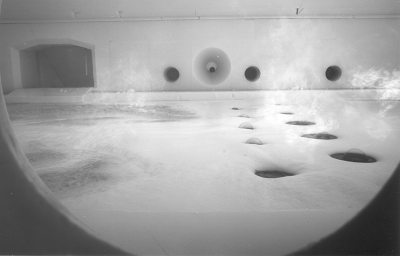
Foaming in an industrial glass tank is most often a very undesirable phenomenon, blocking the heat transfer from the burner flames into the melt. It leads not only to an increased fuel consumption, but may also result in overheating of the crown and too low glass melt temperatures. During his PhD study, Read-Ox’ founder Paul Laimböck studied this phenomon extensively, resulting in the thesis titled “Foaming of Glass Melts”. The topic remains of high interest, due to ever increasing energy prices and quality standards. For this reason it was decided to publish the thesis as an ebook.
Please contact us for downloading the book in the login section.
Topics:
 Gas production of the melt (gas producing redox reactions)
* Effect of redox active additions (sulfate, iron, carbon or coke, nitrate)
* Effect of glass melt basicity (soda, alumina level)
Glass Foam stability mechanism
Foaming of recycling glass mixtures
Foaming of glass melts in oxy-fuel firing conditions
Foam control: formula to determine optimal sulfate level as a function of:
* hotspot temperature
* bulk glass composition
* water level in atmosphere (air-fuel or oxy-fuel firing conditions)
…
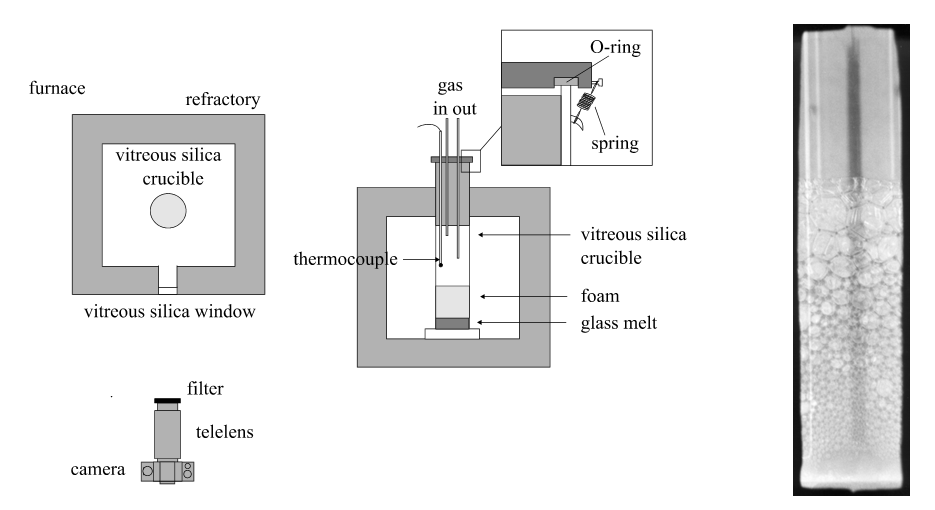
Below a schematic drawing of the set-up is shown, which was used to study the foaming behaviour of various glass forming batches in different atmospheres. Using this set-up, the release of various gas species and the resulting volume expansion of the batch and glass melt could be measured simultaneously as a function of temperature.
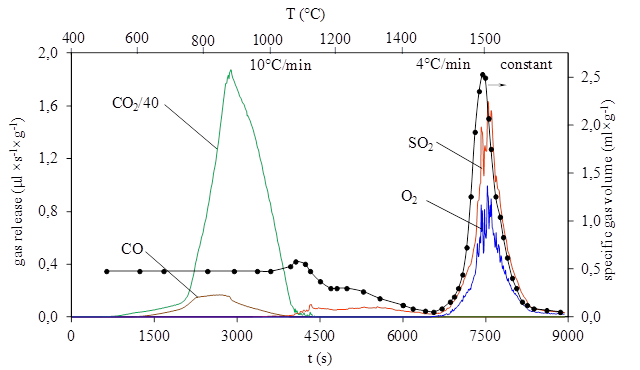
The batch expansion and foaming of an oxidised sulfate containing glass forming batch is shown. It can be seen that there was only a moderate batch expansion due to the entrapment of minor amounts of CO2, CO and SO2 by the glass forming batch, but vigorous foaming above 1450C due to the thermal decompostion of sulfate, releasing SO2 and O2 gas in a molar ratio of 2:1